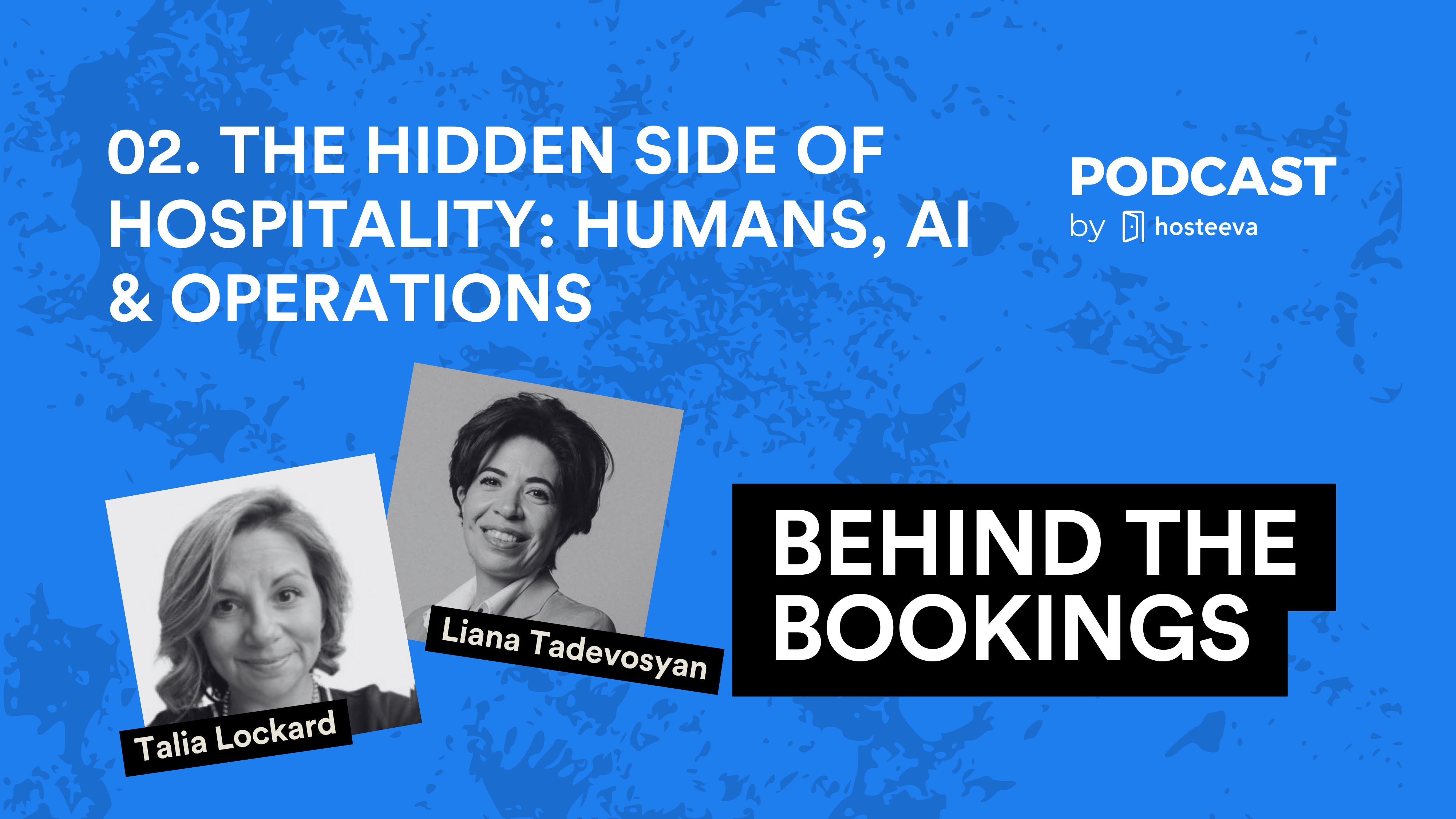
Behind The Bookings 02: The Hidden Side of Hospitality
Hospitality is changing, but the human touch still matters. In this episode of Behind The Bookings, Talia Lockard sits down with Liana Tadevosyan, Head of...
Hosteeva insights
Practical insights, market trends, and smarter strategies for owners and operators
Hospitality is changing, but the human touch still matters. In this episode of Behind The Bookings, Talia Lockard sits down with Liana Tadevosyan, Head of...
Jul 09, 2026
Hospitality is changing, but the human touch still matters. In this episode of Behind The Bookings, Talia Lockard sits down with Liana Tadevosyan, Head of Operations at Hosteeva, to talk about what it really takes to manage short-term rental operations at scale. The conversation covers AI, guest communication, internal processes, team structure, and the importance of listening to operators and guests. Liana shares how Hosteeva uses technology to improve response times, support staff, and make operations more efficient. But the key point is simple: AI is not replacing hospitality. It helps teams move faster, answer guests better, and reduce pressure on operations. Still, empathy, flexibility, and good judgment are what create a truly positive guest experience. From cross-trained teams to AI-powered guest support, the episode shows how modern hospitality works best when technology and people support each other. Featuring Talia Lockard, Director of Sales and Marketing at Hosteeva Liana Tadevosyan, Operations Director at Hosteeva About Behind The Bookings Behind The Bookings is Hosteeva’s podcast series about short-term rentals, hospitality operations, AI, automation, and the systems behind better guest experiences. About Hosteeva Hosteeva helps short-term rental operators, property owners, and developers improve operations through technology, AI, revenue management, and full-service hospitality support. Learn more at www.hosteeva.com
Read more Jun 29, 2026
Every story celebrates the moment someone wins the throne. Very few explore what comes next. The latest episode of House of the Dragon marks the beginning of Rhaenyra's reign, but the crown is not the victory. It is the responsibility. Every decision now carries weight. Every alliance must be maintained. Every conflict must be anticipated before it becomes a crisis. Leadership is no longer about claiming power. It is about creating order from complexity. Hospitality works the same way. Adding more properties is exciting, but growth without systems quickly becomes chaos. More bookings create more guest messages, more maintenance requests, more pricing decisions, more owners to satisfy, and more moving parts that cannot be managed manually forever. The operators who scale successfully understand one thing: sustainable growth isn't built on working harder. It's built on systems that make complexity manageable. That is where Hosteeva comes in. From automation and revenue optimization to guest communication and day-to-day operations, we help transform growing portfolios into businesses that run with precision. Because the real challenge isn't winning the kingdom. It's managing it. Rhaenyra may have the Iron Throne.We'll take care of the portfolio. The Seven Kingdoms. Managed by Rhaenyra.Your portfolio. Managed by Hosteeva.
Read more Jun 27, 2026
The line between hotels and short-term rentals is getting thinner. Guests want the space and comfort of an apartment, but they also want the reliability of a hotel. Owners want income from real estate, but they do not want to manage every message, cleaning task, complaint, and booking manually. Developers want buildings that can attract investors, but they also need a model that performs after the units are sold. This is where a new hybrid model is becoming more attractive: aparthotels, condo-hotels, serviced apartments, and branded residences. Different names, similar logic: separate ownership, centralized management, and a hotel-style guest experience. How the model works In a traditional hotel, one company usually owns or controls the room inventory and manages the guest experience. In the hybrid model, individual units or rooms may have separate owners, but the building is operated through one management structure. A public academic paper on condo hotels explains that condo-hotel ownership is connected to privately owned hotel units managed by one operator, while an apart-hotel refers more to the type of hotel unit, usually an independent apartment with a kitchen or kitchenette. In simple terms: The investor owns the unit.The operator manages the guest experience.The PMS connects the operation.The guest experiences it like a hotel. This model can include reservations, pricing, housekeeping, maintenance, guest communication, payments, reporting, and owner statements under one system. Why guests like it Guests increasingly want flexibility. They may want a kitchen, more space, longer stays, a separate living area, or a more residential feeling. But they still expect fast replies, clean rooms, smooth check-in, and support when something goes wrong. That is why serviced apartments and aparthotel-style products continue to attract attention. HVS reported that Europe’s serviced apartment sector had a solid 2024 performance, with occupancy increasing by 3.8% and RevPAR increasing by 4.4% between 2023 and 2024 across the surveyed properties. The product fits modern travel behavior: business trips, relocation, family travel, extended stays, and guests who want more than a small hotel room. Why owners and developers like it For owners, the model offers a way to earn from hospitality without becoming a full-time hotel manager. For developers, it can make units more attractive because the property is not just sold as real estate. It is sold with an operating concept behind it. For operators, it creates scale. Instead of managing disconnected apartments across the city, the operator can manage a full building or portfolio through one system, one brand standard, and one guest service model. This is also connected to the growth of branded residences. Savills reported that global branded residence schemes were expected to grow from 764 in December 2024 to 910 by the end of 2025, a 19% year-on-year increase. The message is clear: real estate, hospitality, and operations are becoming more connected. Is it more profitable? It can be, but only when the model is managed properly. Profitability depends on location, demand, seasonality, pricing strategy, service quality, owner agreements, operating costs, and the strength of the management system. The same academic paper notes that long-term profitability in condo hotels depends on factors such as location, season duration, guest reputation, sales effectiveness, facility category, network membership, and available attractions. So the model itself is not magic. The system behind it is what makes it work. Without a strong PMS, the model can become messy very quickly. Different owners, different units, different calendars, different payments, different expectations, and different reporting needs can create serious operational pressure. Why this model needs a strong PMS A hybrid hotel model cannot run on spreadsheets and WhatsApp. It needs a system that can handle: Reservations Channel distribution Guest communication Owner reporting Housekeeping tasks Maintenance workflows Payments and statements Performance visibility AI-supported communication 24/7 support This is exactly where Hosteeva fits. Hosteeva Platform gives operators, hotels, and owners a connected system to manage the operational side of the business. It is especially useful when multiple owners or multiple units need to be managed under one structure. Hosteeva Hosted adds extra support, including Eva AI, team assistance, and 24/7 support. This helps create a more hotel-like experience without forcing the owner or operator to manually handle every guest interaction. The future hotel may not look like the old hotel The next hospitality model may not be purely hotel or purely STR. It may be a professionally managed building with individually owned units, apartment-style comfort, hotel-level service, AI-supported communication, and one platform connecting the entire operation. For guests, it feels simple. For owners, it creates income potential. For operators, it creates scale. For developers, it creates a stronger investment story. But for the model to work, the experience must be consistent. Guests should not feel the difference between Unit 203 and Unit 504 because the owners are different. They should feel one brand, one standard, one service level. That is the new hotel standard. And it needs a system built for it.
Read more Jun 18, 2026
For years, short-term rentals grew fast. Owners listed properties, guests booked them, and cities tried to understand what was happening in real time. Now the industry is entering a new phase. Barcelona is one of the clearest examples. The city plans not to renew tourism licenses for short-term rentals after 2028, and one of Spain’s top courts backed the plan in 2025. Reuters reported that Barcelona’s plan covers more than 10,000 short-term rental apartments and is part of a wider effort to address housing pressure. That does not mean STR is dead. It means STR is growing up. The casual hosting era is getting harder The biggest lesson from Barcelona is not “stop investing in STR.” The real lesson is that cities are becoming more serious about how short-term rentals operate. This is not happening only in Spain. New York City adopted Local Law 18, which requires short-term rental hosts to register with the Mayor’s Office of Special Enforcement and prevents booking platforms from processing transactions for unregistered rentals. Across Europe, the EU’s Regulation 2024/1028 is also changing the data environment around STR. The European Commission says the rules create a common framework for collecting and sharing data from hosts and online platforms, with registration numbers, platform verification, and monthly data sharing through national digital entry points when member states use the framework. The direction is clear: governments want more visibility, better registration, and stronger control over illegal or unstructured listings. What this means for owners For owners, regulation is not just a legal topic. It is a business topic. A property that is not properly registered, documented, or professionally operated may become harder to sell, harder to list, harder to scale, and harder to trust. In regulated markets, owners need to know what is allowed, what data is required, what platforms can display, and how guest stays are reported. The owner who treats STR as a casual side project may struggle. The owner who treats STR as a professional hospitality business will be more prepared. The future belongs to structured operators A stronger regulatory environment does not remove opportunity. It changes what kind of owner can succeed. The future STR owner will need: Clear documentation Organized booking records Professional guest communication Reliable reporting Multi-channel visibility Strong operational workflows Fast support Better control over performance This is where a platform-based approach becomes important. Hosteeva’s role in the new STR reality Hosteeva helps owners move away from scattered manual management and toward a more structured operating model. With Hosteeva Platform, owners can manage reservations, communication, reporting, and performance from one connected system. This matters because in a regulated market, visibility is no longer optional. Owners need to know what is happening across their properties, channels, guests, and operations. With Hosteeva Hosted, owners get the platform plus additional support, including Eva AI, team assistance, and 24/7 support. This gives owners a stronger operational backbone without forcing them to handle everything manually. Hosteeva has partnered with 10,000+ STR owners around the world, and that global experience matters in a market where rules, guest expectations, and distribution channels are changing quickly. Regulation does not kill STR. Poor preparation does. The Barcelona story is important because it shows how quickly a city can change the rules of the game. But it also shows something bigger: STR is becoming a more professional industry. Owners should not panic. They should prepare. That means checking local rules, keeping documents organized, understanding platform requirements, improving guest communication, and using systems that create operational clarity. The future of STR will not belong to owners who simply list a property and hope for bookings. It will belong to owners who operate like professionals. And professional owners need professional systems.
Read more Jun 08, 2026
Short-term rental owners do not just manage properties. They manage questions, check-ins, complaints, pricing updates, channel messages, cleaning schedules, late-night requests, and the constant fear of missing something important. That is why every STR owner eventually wants the same thing: an assistant who is fast, organized, always available, and does not panic when five guests message at the same time. Meet Eva AI, Hosteeva’s AI assistant built to support smarter short-term rental operations. Guest communication is no longer a small task In STR, communication can decide whether a guest books, stays happy, leaves a good review, or comes back. Airbnb itself encourages hosts to respond to inquiries and reservation requests within 24 hours and notes that quick responses help build trust in the hosting community. But for real owners, especially those managing multiple units, “respond within 24 hours” is not enough anymore. Guests expect answers quickly. They ask about check-in, Wi-Fi, parking, early arrival, amenities, local recommendations, refunds, damage, access codes, and everything in between. And they usually do not ask when it is convenient for the owner. That is where Eva AI becomes valuable. Eva AI is the assistant behind faster operations Eva AI helps Hosteeva support guest communication with more speed and consistency. It is not just a nice tech feature. It is part of a bigger operating system that helps owners reduce manual pressure and make the guest experience feel more professional. Hosteeva’s average response time is around 30 minutes, compared to the market average of around one hour. For an STR owner, that difference matters. A faster reply can protect a booking, calm a guest, reduce confusion, and improve the overall experience. Eva AI works together with Hosteeva’s platform, workflows, and 24/7 support structure, helping the operation move faster without depending only on manual replies. Why owners need AI, not just more effort Many owners try to solve operational problems by working harder. They answer more messages, check more platforms, stay online longer, and keep more things in their head. That can work for one property, maybe two. But once the portfolio grows, manual management becomes risky. The problem is not the owner. The problem is the system. Eva AI helps owners move from reactive management to smarter support. Instead of waiting for every issue to become a personal task, owners can rely on a more connected structure where AI, people, and platform tools work together. Where Hosteeva Platform and Hosted fit in For owners who want control, Hosteeva Platform gives them a connected system to manage reservations, reporting, communication, and performance. For owners who want the system plus support, Hosteeva Hosted adds Eva AI, team assistance, and 24/7 support. This is especially useful for owners who want to stay informed without being involved in every small operational issue. Hosteeva has partnered with 10,000+ STR owners around the world, and the logic is simple: owners do not only need software. They need a system that helps them operate better. The future STR owner will not manage manually The next generation of STR ownership will be faster, more automated, more data-driven, and more guest-focused. Owners who still rely only on manual communication will feel the pressure first. Eva AI gives owners what they actually need: more speed, more consistency, and less daily chaos. Because the best STR owners are not trying to answer every message themselves. They are building a system that answers better.
Read more May 13, 2026
Summer is one of the most profitable seasons for short term rentals, but it is also one of the easiest times to lose revenue through poor pricing decisions. Many operators assume summer pricing simply means increasing nightly rates. In reality, successful revenue management is far more dynamic. The strongest STR operators constantly adapt to market demand, traveler behavior, local events, and booking pace. Here are some of the most important summer pricing strategies every operator should understand. 1. Avoid Static Summer Pricing Summer demand changes constantly. A holiday weekend, local festival, sports event, or weather shift can dramatically affect booking behavior within days. Operators using one fixed “summer price” often miss opportunities to maximize revenue or maintain occupancy. Pricing should move with the market. Hosteeva’s dynamic pricing system helps automate these adjustments in real time while still operating within the owner’s preferred pricing rules, limits, and operational strategy. Instead of manually updating rates every day, operators can react faster to changing demand while maintaining control. This operational flexibility becomes especially important in fast-moving hospitality environments where pricing decisions directly impact profitability. 2. Pay Attention to Shoulder Nights One of the most overlooked strategies in hospitality is optimizing the nights around major events. If an event happens Friday and Saturday, many travelers may also book Thursday or Sunday depending on flights, schedules, and travel plans. The goal is not only filling the peak nights.The goal is increasing total stay value. A longer booking around an event can outperform a higher nightly rate on fewer nights. This strategy becomes especially powerful in event-driven summer markets where booking behavior shifts quickly. This topic is also explored in the first episode of Behind The Bookings, Hosteeva’s hospitality podcast series, where Hosteeva professionals discuss shoulder-night strategy, pricing behavior, and the booking patterns operators should pay attention to during peak season. Watch the episode here: 3. Booking Windows Matter Different markets book differently. Some destinations receive reservations months in advance. Others move almost entirely last minute. Understanding your market’s booking window helps avoid two common mistakes: pricing too low too early panicking and discounting unnecessarily Revenue management should follow market behavior, not emotions. At Hosteeva, operators can monitor booking pace, occupancy trends, and reservation activity through centralized operational dashboards designed to simplify decision-making across properties and sales channels. 4. Events Do Not Always Mean Higher Prices Not every event creates the same type of traveler. Some concerts generate one-night stays.Some conferences create weekday demand.Some sports events drive longer bookings. Understanding who is traveling matters just as much as knowing what event is happening. Smart operators study demand patterns, not just event calendars. This is where market intelligence becomes critical. Revenue optimization is not about reacting emotionally to events. It is about understanding traveler behavior and adjusting strategically. 5. Listing Presentation Impacts Revenue Pricing alone does not drive bookings. Photos, amenities, and listing positioning heavily influence how travelers perceive value. Travelers compare listings quickly. Strong visuals and experience-focused presentation can often support higher pricing more effectively than discounting. The best-performing listings sell the experience, not just the property. Properties with clear operational consistency, faster communication, and stronger guest experience also tend to maintain better long-term pricing power and review performance. 6. Use Data, Not Guesswork Modern hospitality markets move too quickly for manual pricing alone. Successful operators monitor: occupancy pacing local demand market trends traveler behavior event schedules competitor positioning The operators who adapt fastest usually perform best. Hosteeva clients gain access to operational analytics tools, performance insights, and support from hospitality professionals who help monitor revenue trends, pricing opportunities, and market behavior across their portfolio. For many operators, access to accurate data becomes one of the biggest competitive advantages during peak season. As explored in Hosteeva’s article Most Hospitality Automation Projects Solve the Wrong Problem, successful hospitality operations are not built on disconnected tools. They are built on connected systems that reduce operational friction and improve decision-making. The same principle applies to pricing strategy. Final Thought Summer pricing is not about charging the highest rate possible. It is about balancing occupancy, demand, traveler psychology, and operational strategy to maximize long-term performance. The operators who approach pricing strategically, instead of emotionally, usually outperform the market. And as explored in The STR Devil Wears Hosteeva, success in hospitality often comes down to the details behind the scenes. The timing, the systems, the guest experience, and the operational precision that travelers may never notice directly, but always feel. In modern hospitality, small operational decisions create the biggest long-term differences.
Read more