Overview:
This article outlines the process for Airbnb Suspended and "Pending removal" listings. Below are the outlined procedural steps:
1. Listing Suspension Main Reasons
2. Suspended Listings
3. Listing Reactivation
4. “Pending removal” Listings
5. Listing Appeals
1. Listing Suspension Main Reasons
Airbnb requires all Hosts to follow its Ground rules and Circumvention policy, which help create comfortable, reliable stays for guests. When violations occur, Airbnb aims to first provide information to Hosts about the policy and issue warnings. However, Airbnb may temporarily suspend or remove listings for repeated or severe violations of the ground rules. The following are the primary ground rules, violations of which may result in listing suspension.
- Reservation commitment
- Timely communication
- Listing accuracy
- Listing cleanliness
Temporary listing suspensions usually take 5 business days. This means the suspended listing is removed from search results and is not bookable.
2. Suspended Listings
Below are the steps that take place after each listing suspension:
- Reputation Team assesses the listing issues/reviews and submits a comprehensive list of aforementioned that caused the suspension to local teams of Managed areas/forwards information to the account manager of the Hosted property within the next 24-48 hours.
- Local teams of Managed areas are required to provide the documentation (deep cleaning invoices, timestamped photos, and videos of updated amenities and replaced, repaired items, etc.) within the next 3 days to get the listings reactivated. Hosted properties will be automatically reactivated once the suspension period ends.
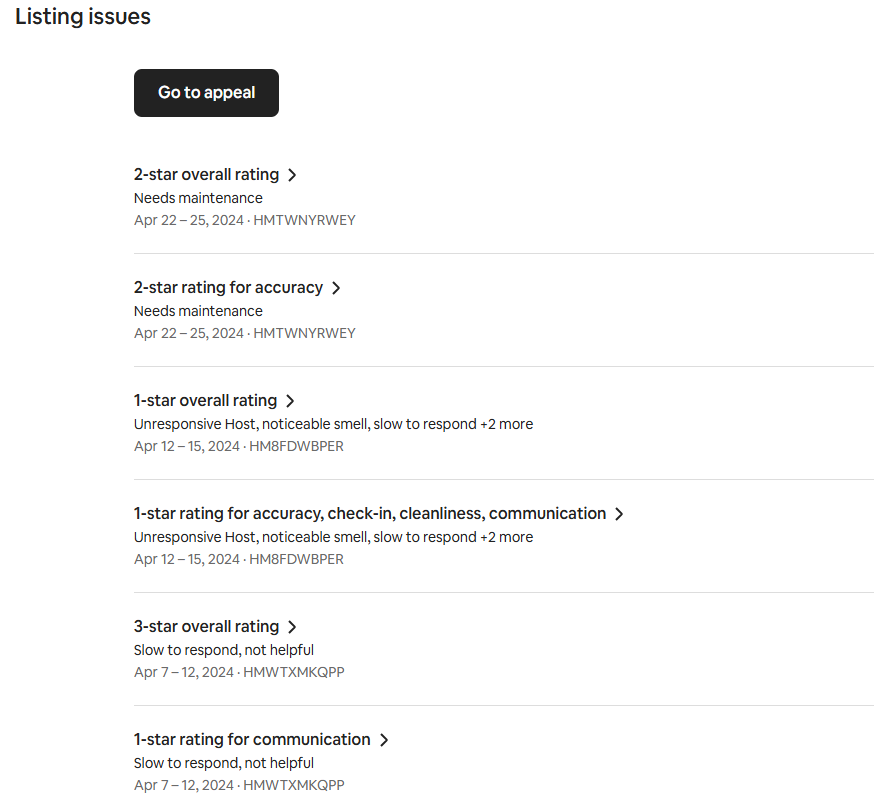
Listing issues overview
3. Listing Reactivation
Once the required documentation is collected and saved on the listing’s Trello ticket, the Reputation Team proceeds to reactivate it on Airbnb. However, it's important to note that agreeing to Ground rules and reactivating the listing does not imply that the listing issues have been removed from the listing’s appropriate page on Airbnb. Airbnb continues to collect data on areas for improvement from reviews and guests' reports, and if the issues continue happening and reoccurring, they may result in a change in status to "Pending removal".
4. “Pending removal” Listings
In the event of repeated or severe violations of the Ground rules, detection of a listing as a duplicate, or relisting, Airbnb changes the listing's status to "Pending removal". Hosts are given 14 days to appeal this decision after the status change. The process of re-activation in this case is much more complex and needs more documentation.
5. Listing Appeals
Airbnb encourages the hosts to share additional details or documentation for consideration before a final decision regarding the permanent removal of the listing is made.
Below are the steps that take place after the listing gets “Pending removal” status:
- Reputation Team assesses the issues and reviews that led to the listing's status change and notifies local teams of the Managed areas/representatives and account managers of the Hosted properties within 24-48 hours.
- Local teams of the Managed areas/representatives of the Hosted properties are required to provide the documentation as soon as possible but no later than the deadline set in Reputation team communication, to commence the appeal process.
- Once the required documentation is collected and saved on the listing's Trello ticket, the Reputation Team submits an appeal. Additional documentation may be requested at Airbnb's discretion.
It's important to highlight that listings may be assigned "Pending removal" status if they are detected as duplicate or relisted, as shown in the screenshot below: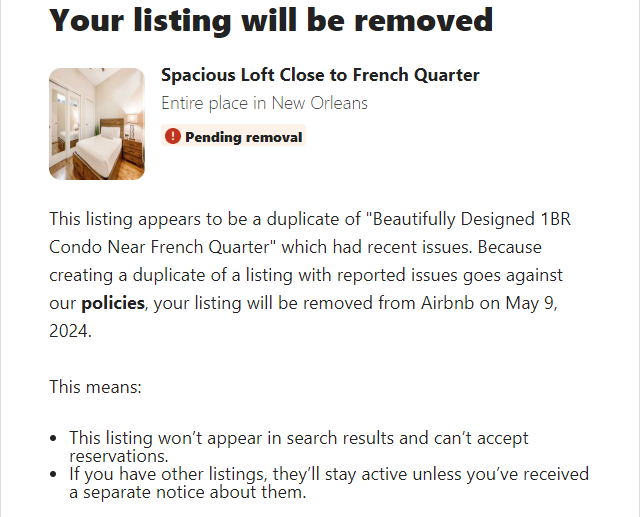
Pending removal notification (duplicate / relisted)
These cases often require unique investigation to identify methods of proving that the unit was never relisted or convincing Airbnb to reactivate it on their platform. As Airbnb continuously updates its tools to detect such properties, it's imperative to understand that relisting is no longer a viable option for hosts.