For years, short-term rentals grew fast. Owners listed properties, guests booked them, and cities tried to understand what was happening in real time.
Now the industry is entering a new phase.
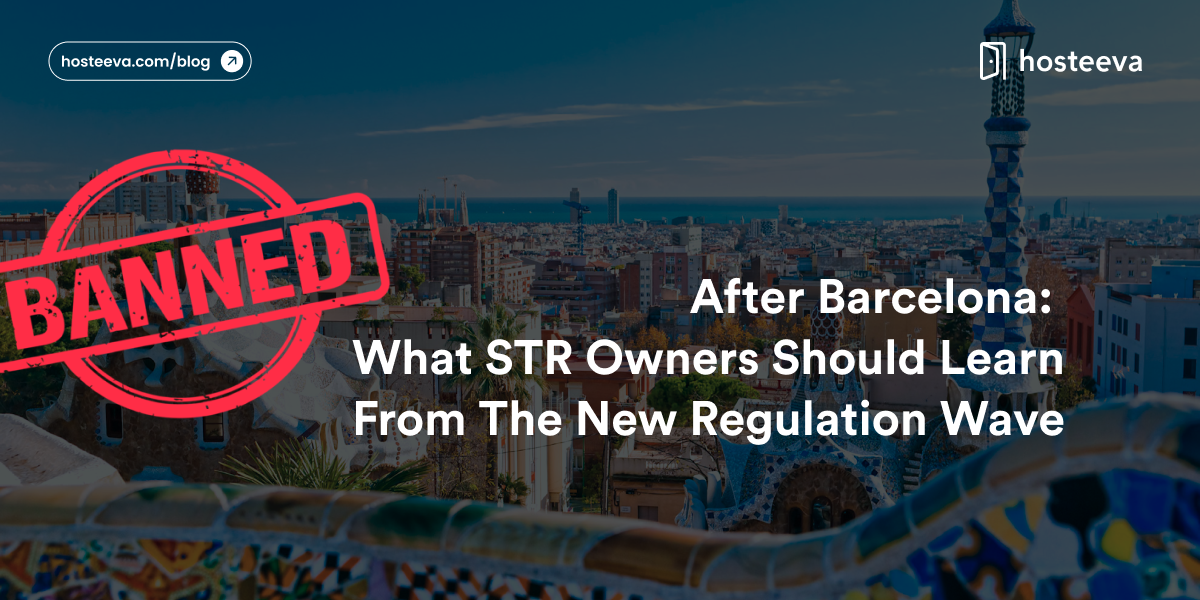
Barcelona is one of the clearest examples. The city plans not to renew tourism licenses for short-term rentals after 2028, and one of Spain’s top courts backed the plan in 2025. Reuters reported that Barcelona’s plan covers more than 10,000 short-term rental apartments and is part of a wider effort to address housing pressure.
That does not mean STR is dead.
It means STR is growing up.
The casual hosting era is getting harder
The biggest lesson from Barcelona is not “stop investing in STR.” The real lesson is that cities are becoming more serious about how short-term rentals operate.
This is not happening only in Spain. New York City adopted Local Law 18, which requires short-term rental hosts to register with the Mayor’s Office of Special Enforcement and prevents booking platforms from processing transactions for unregistered rentals.
Across Europe, the EU’s Regulation 2024/1028 is also changing the data environment around STR. The European Commission says the rules create a common framework for collecting and sharing data from hosts and online platforms, with registration numbers, platform verification, and monthly data sharing through national digital entry points when member states use the framework.
The direction is clear: governments want more visibility, better registration, and stronger control over illegal or unstructured listings.
What this means for owners
For owners, regulation is not just a legal topic. It is a business topic.
A property that is not properly registered, documented, or professionally operated may become harder to sell, harder to list, harder to scale, and harder to trust. In regulated markets, owners need to know what is allowed, what data is required, what platforms can display, and how guest stays are reported.
The owner who treats STR as a casual side project may struggle.
The owner who treats STR as a professional hospitality business will be more prepared.
The future belongs to structured operators
A stronger regulatory environment does not remove opportunity. It changes what kind of owner can succeed.
The future STR owner will need:
- Clear documentation
- Organized booking records
- Professional guest communication
- Reliable reporting
- Multi-channel visibility
- Strong operational workflows
- Fast support
- Better control over performance
This is where a platform-based approach becomes important.
Hosteeva’s role in the new STR reality
Hosteeva helps owners move away from scattered manual management and toward a more structured operating model.
With Hosteeva Platform, owners can manage reservations, communication, reporting, and performance from one connected system. This matters because in a regulated market, visibility is no longer optional. Owners need to know what is happening across their properties, channels, guests, and operations.
With Hosteeva Hosted, owners get the platform plus additional support, including Eva AI, team assistance, and 24/7 support. This gives owners a stronger operational backbone without forcing them to handle everything manually.
Hosteeva has partnered with 10,000+ STR owners around the world, and that global experience matters in a market where rules, guest expectations, and distribution channels are changing quickly.
Regulation does not kill STR. Poor preparation does.
The Barcelona story is important because it shows how quickly a city can change the rules of the game. But it also shows something bigger: STR is becoming a more professional industry.
Owners should not panic. They should prepare.
That means checking local rules, keeping documents organized, understanding platform requirements, improving guest communication, and using systems that create operational clarity.
The future of STR will not belong to owners who simply list a property and hope for bookings.
It will belong to owners who operate like professionals.
And professional owners need professional systems.